



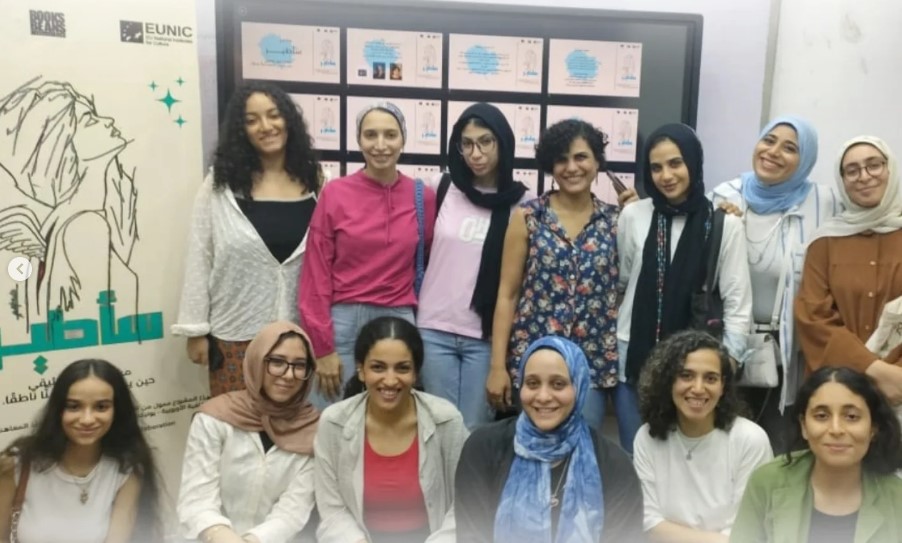
“I wanted to fly, but the world was too small.” This is how Haidi Fares sums up her personal journey, as if drawing with a single simple line the story of a girl who found in painting not just a talent, but a way out of a suffocating social siege. In her small room in Mansoura, colors were her first means of expanding her horizons. She would put a blue dot in the middle of a gray space and say to herself: “I am here… and I still have colors.”
But the journey from a girl who painted to escape her troubles to an artist who opens up spaces for others was not purely coincidental. Haidi observed how the silence of girls in her community turned into solid walls, how dreams were trapped in phrases like “it’s no use” and “it’s not right,” and how art could be a gentle but stubborn act of resistance.
Haidi Fares: Artist and Creative Space Manager
Haidi Fares is a visual artist and founder of the “I Will Fly” initiative. She also manages a small cultural space in Mansoura called “Books & Beans,” which combines a library and a workshop space. It was here that she took the first steps of her project, albeit under a different name and in a simpler form.
These sessions brought girls together in a friendly atmosphere, where they drew together and spoke openly about their feelings and experiences, as if they were sitting in an informal support group. Over time, these sessions evolved from a side activity within Books & Beans to a broader and clearer idea, until the Sa’aytar initiative was born with its clear goal of creating safe spaces for girls in Mansoura.
From the inside: The birth of the Sa’aytar idea
“Sa’ir wasn’t a planned project from the beginning,” says Haidi. “It was more of an instinctive act. I needed to create a space where I could breathe… I knew that others needed it even more than I did.”
After years of teaching art, Haidi realized that the problem ran deeper than teaching skills. Girls in Mansoura, like many cities filled with invisible restrictions, were looking for a place where they could say, “I’m not okay… and it’s okay to say that.”
The sessions began simply at Books & Beans: a small circle of girls drawing and talking without fear. But over time, Haidi felt that this small space could turn into something bigger. With support from a grant from EUNIC, the workshops began to take shape as a clear initiative, but their essence remained the same: “drawing as a space for confession.” The workshops were not intended to create professional artists, but rather women who could safely acknowledge their feelings.
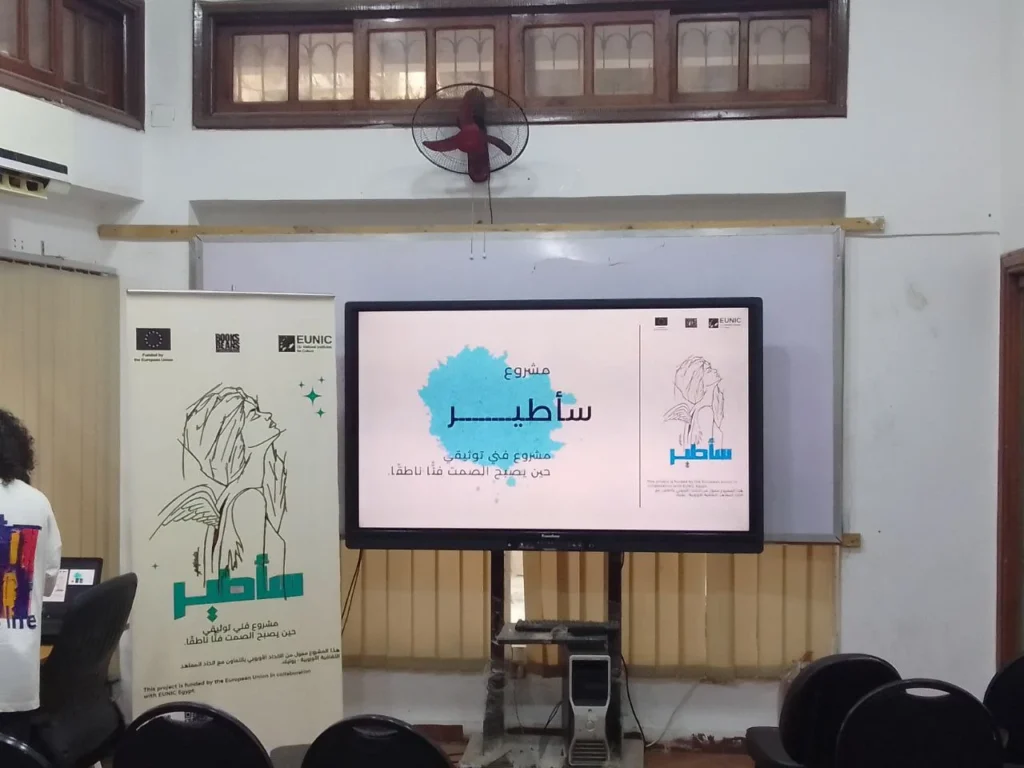
At the heart of the workshop: girls learn to see themselves
In one of the workshops, Haidi sat in front of a group of girls and said quietly, “It doesn’t matter if you draw well… what matters is that you express yourselves with colors.” This simple sentence was the key. It was enough for a girl who entered the workshop shyly, barely whispering her words, to hear it to end the day having painted a picture full of warm colors, as if she had let out a muffled cry that had been trapped inside her for years.
The workshops are run on a simple but revolutionary principle: no evaluation, no comparisons, no orders. Every girl who comes to the workshop carries a story inside her, and she is only asked to tell it in her own way. Blue became freedom for one girl, red became an expression of anger pent up for years, and each painting was a new page in a notebook of confessions that no one would judge.
Haidi did not teach painting; she opened a small window for each girl through which she could say, “I am here,” even if she could not say it out loud.
Haidi Fares: The artist who heals her wounds with colors
Behind every workshop, Haidi was living a parallel experience as an artist. She says, “I heal when I paint… Every painting feels like it’s bringing out old pain.” In her artwork, the vocabulary of female pain is embodied in disturbing physical forms: bodies hollowed out from within, eyes searching for light, and overlapping lines that reflect the psychological turmoil she knows so well.
For Haidi, painting was never just an aesthetic act, but a means of resisting feelings of helplessness and attempting to repair what her experiences had broken. While helping girls acknowledge their feelings, Haidi herself acknowledged her wounds through each painting.
I Will Fly… A Dream That Doesn’t Just Need Wings
“I Will Fly” wasn’t just a name Haidi chose for her initiative; it was a personal statement. But it’s a statement that needs real space, one that recognizes girls’ right to be heard and to express their vulnerability without fear of judgment or shame.
Haidi dreams that one day the workshops will turn into group exhibitions, where every girl will find a place to hang her painting and say to the world, “I am here.” But she realizes that the road is not easy. The challenges go beyond funding and logistical support. She says, “Society needs to recognize that these projects are not luxuries… they are a psychological necessity in a city that stifles the soul.”
Haidi knows very well that breaking down walls of silence does not happen with a single blow. It takes hundreds of small cracks, which is what the workshops are quietly and stubbornly doing.
Art as a gentle act of resistance
At a time when feminist initiatives are on the rise in Egypt, “I Will Fly” stands out as something different. It is not an initiative that raises grand slogans, but one that opens small cracks in the walls of silence.
Haidi says: “I’m not teaching girls to start a revolution… I’m teaching them to listen to themselves… The real revolution starts here.” Every new workshop, every girl who picks up a brush for the first time and discovers she can paint what she couldn’t say, is a small but significant victory.
The invisible but profound impact
Sa’atir may not be in the media spotlight, but for the girls who have gone through the experience, it represents a turning point. Haidi tells the story of a girl who came from a small village and, after the first workshop, whispered to her, “This is the first time I’ve talked about myself… and the first time I’ve felt that it’s not a bad thing.”
It is these fleeting moments, which may seem insignificant, that give Haidi the feeling that her project is on the right track. Every small admission is a step closer to the sky.
The dream continues
Haidi is not looking for a huge project with a big budget; she believes that power lies in the small details. She dreams that “I Will Fly” will spread as an idea, as a simple method that any girl can start in her room, even if the world seems small.
She says: “I’m not offering alternative therapy… I’m not trying to create international artists… I’m opening a small window for girls… The rest will happen on its own.”
Read also
A theater that will never die… Mansoura saves its heritage and restores it as an opera house
The features of Eid are changing in the streets of Mansoura: Batina occupies the city
