



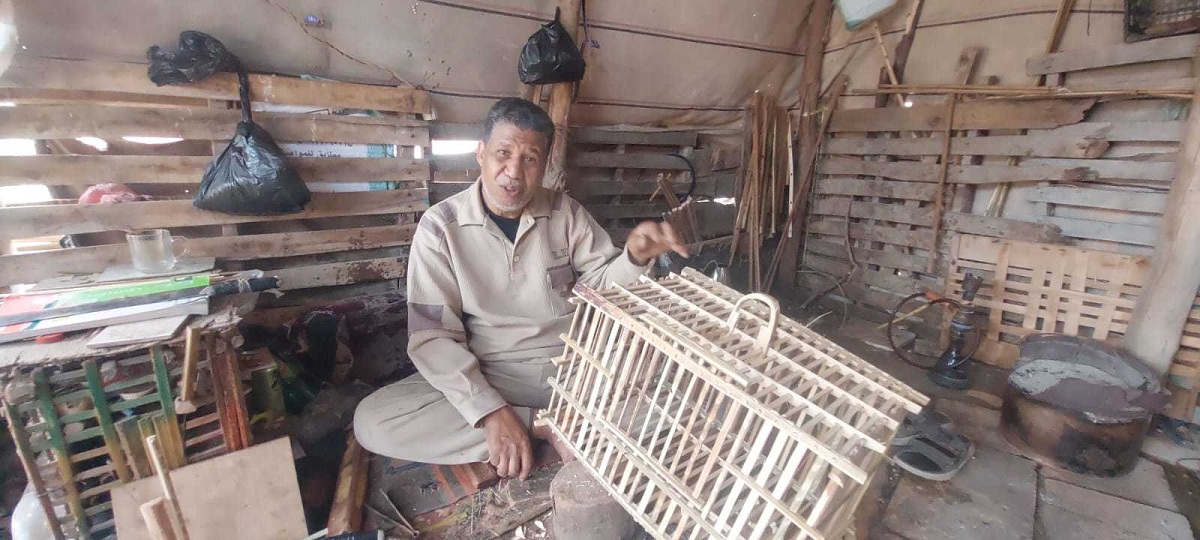
The rhythmic beauty, economic hardship, and generational legacy of Egypt’s vanishing handmade crate industry.
By Helmy Yassin
Here, in the heart of the Kafr Al-Battikh district within the Damietta Governorate, one of the region’s most venerable manual crafts teeters on the precipice of oblivion. The industry of Gareed (palm frond) crates, an ancient labor long entwined with the rhythmic cycles of Egyptian agriculture and trade, now faces a relentless onslaught of modern alternatives. As plastic bins and corrugated cardboard boxes flood the market, this hallowed tradition struggles to anchor itself in a changing world.
The Locomotive of Progress or the Vessel of Heritage?
Hajj Ahmed Abdel Azim, 63, a son of Kafr Al-Battikh, affirms that this city remains the central pulse for the Gareed industry in Damietta. Here, hundreds of artisans labor, having inherited the craft through a lineage of generations, relying upon it as their primary lifeline. For decades, these hand-woven crates served as the essential vessels for transporting and storing the land’s bounty of vegetables and fruits, before their prominence began to wither under the shift toward contemporary packaging.
The Alchemy of Production and Raw Earth
Abdel Azim explains that the craft’s soul resides in the Gareed (the sturdy midrib of the date palm leaf), harvested from local groves following the frantic energy of the date harvest. The fronds undergo a rigorous seasoning period, laid bare beneath the searing sun until they achieve the precise zenith of hardness and flexibility. Only then are they ready to be shaped by hand into crates of varying dimensions, tailored to the specific demands of the marketplace.
Recalling the industry’s golden age, Abdel Azim describes workshops that hummed with ceaseless activity before the rise of plastic. In those days, a single order might demand thousands of pieces at once. “We used to stitch night into day, and day back into night,” he reminisces, “striving to fulfill orders for two or three thousand crates of every size. A single commission could occupy us for two full months.”
A Reservoir of Income
Hajj Abdel Azim notes that this era provided a stable economic sanctuary for the craftsmen. The trade absorbed a vast workforce of all ages, including seasonal laborers who sought refuge in the craft. For many, it served as a vital supplementary income, a financial anchor alongside other pursuits.
He maintains that despite the grueling physical toll, there was a profound sense of fulfillment in providing a livelihood for so many families. This prosperity vanished with startling speed as demand shriveled, leaving workshop owners to survive on meager requests that pale in comparison to the industry’s storied past.

Between Tomato Harvests and the Artisan’s Chair
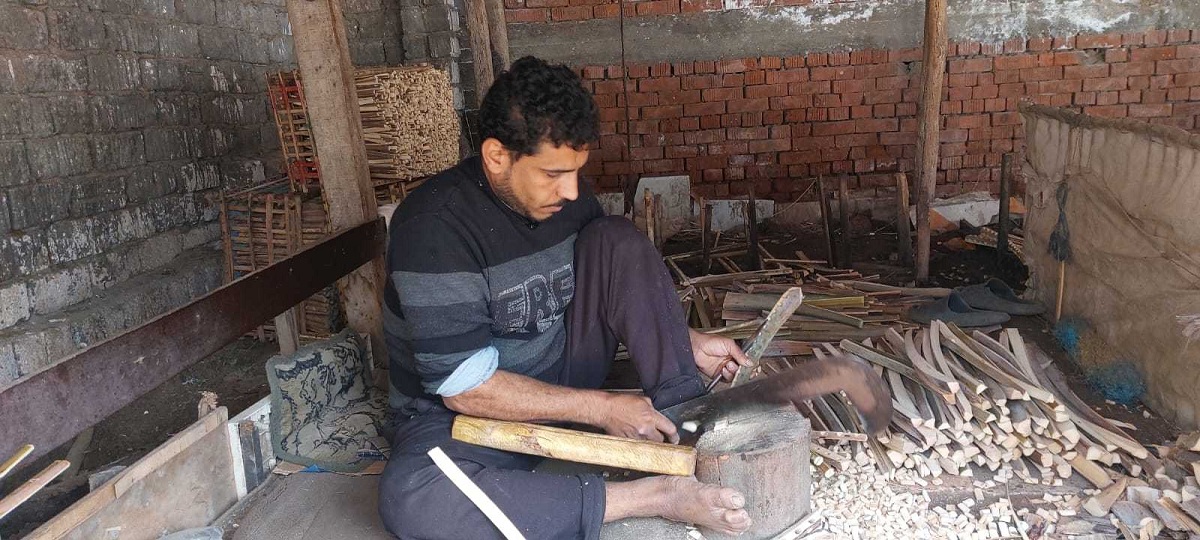
El-Sayed Rabie, a workshop owner in Kafr Al-Battikh, observes that the industry has undergone a stark contraction. In recent years, the use of Gareed crates has been largely relegated to the tomato trade, as plastic and cardboard have usurped their role for delicate harvests like mangoes, strawberries, grapes, and guavas.
He explains that the utility of the palm frond is now restricted to a few niche purposes: the tomato harvest, the construction of rustic cafe furniture, the Shabriya (traditional wooden bread racks) used to preserve loaves, and specialized pigeon coops. Rabie warns that the craft is approaching a point of extinction. The continued reliance on these crates for tomatoes represents the final lifeline; should a cost-effective modern alternative emerge for that specific crop, the Gareed crate may vanish entirely, casting hundreds of families into economic uncertainty.
The Discipline of the Taliha
Karim Tayel, an artisan at the workshop, explains that the plummeting price of a finished crate forces them to endure exhausting hours. To earn a livable wage, they labor under the Taliha (a daily production quota) system.
“The work demands a mechanical rhythm, a constant preparation for the moment of assembly,” Tayel says. “Most of our lives are spent within these walls; even our late-night vigils happen here. If we slacken for even a moment, the loss is immense.”
To endure the isolation, the workers cultivate a domestic interiority within the shop. A television hums in the background after formal hours, and they brew tea, coffee, and even cook their meals on-site. A separate, reinforced room stands ready, a small sanctuary against any potential hazards of the trade.

A New Generation’s Gaze
Mohamed Tayel has been immersed in the craft for thirteen years. He was thrust into the workshop at the tender age of six, assuming the mantle of responsibility for his family following his father’s death. Though he initially intended to stay for a single year, circumstance anchored him to the trade, even as he earned his commercial diploma three years ago.
Tayel describes the labor as punishing, noting the physical toll the constant exertion has exacted on his body. Yet, he finds a solitary virtue in the work: the liberty of being his own master, free from the rigid clock-watching of a corporate office. Still, he emphasizes that the craft requires a sharp, unwavering focus. The most difficult stages, such as the three-step piercing of the Janbiya (the side-slats of the 90bvcrate), demand total presence of mind to avoid a ruinous error or a jagged injury.
