




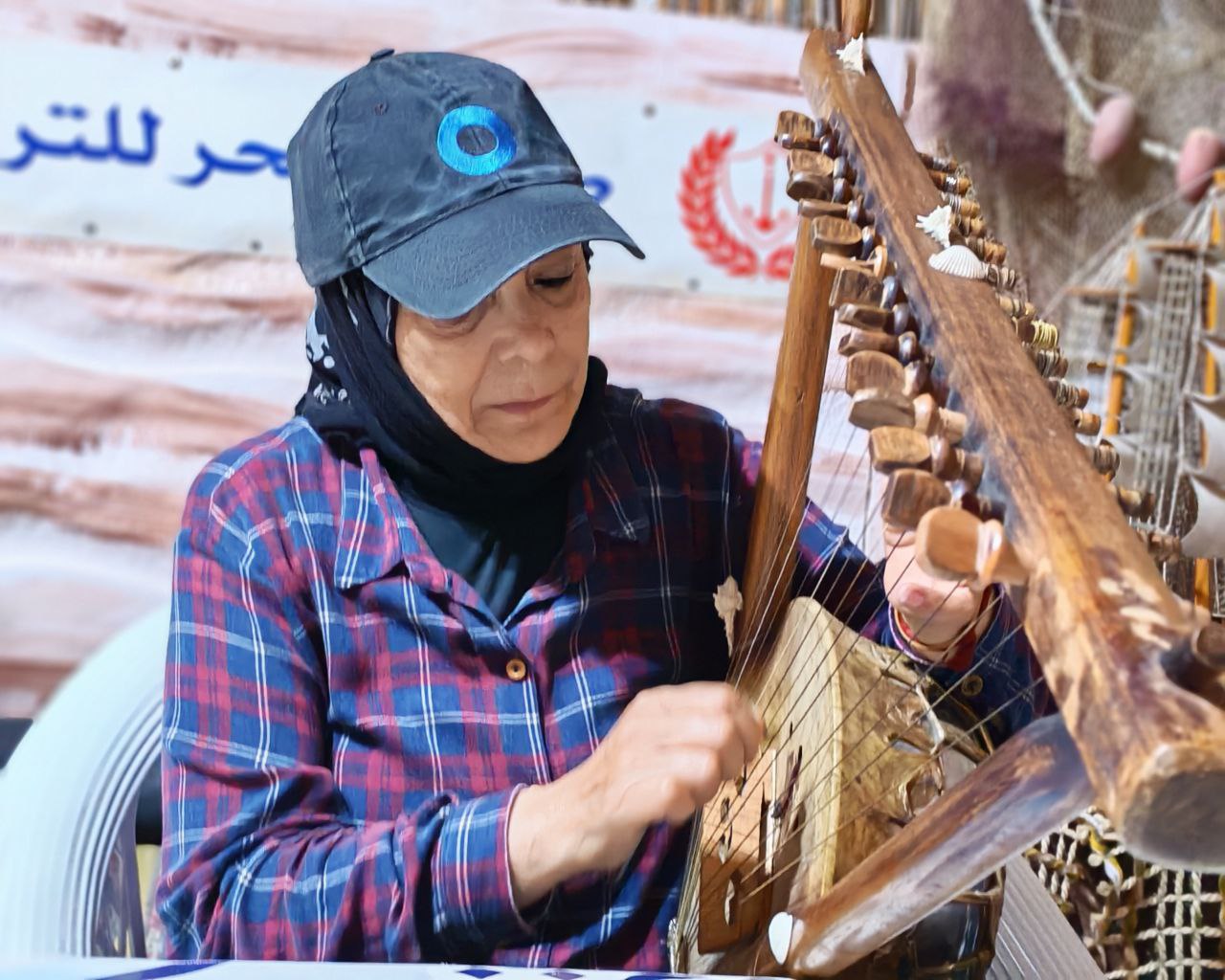
On the strings of the simsimiyya, artist Fatima Al-Morsi has written a unique chapter in women’s history, challenging traditions in a city accustomed to singing for resistance.
From the heart of Port Said, the first female simsimiyya player tells the story of an instrument that sings for the homeland and passes on heritage with a melody that sounds like the sea.
-
First, we would like to get to know you better. Who is Fatma Al-Morsi?
I am Fatma Al-Morsi, the first woman to play the traditional Port Said simsimiyya, and leader of the folk and heritage arts group Sawt Al-Bahr (Voice of the Sea). I come from a long line of artists. My father, Al-Reis Al-Morsi, was one of the most prominent makers of the simsimiyya and wrote the lyrics to its most famous songs in the canal cities.
I grew up in an environment filled with art, and folk art has been an integral part of my daily life since childhood. I learned to play easily because the simsimiyya was always present in our home. One of my sisters played the tambourine and the other played the spoons, and we formed a small house band. I grew up in this creative environment, which made me the first woman to play the simsimiyya in Egypt, and perhaps in the world.
-
How did your journey with the simsimiyya begin? When was your first real experience on stage?
I started playing at an early age, before we were displaced from Port Said, where I used to play with my father and his friends in cafes and on the streets. With the displacement and my brothers away doing military service, my father needed someone to accompany him while he played, so he asked me to join him. I was 13 at the time, and he asked me, “Can you play on your own? Won’t you be scared?” I replied enthusiastically, “I won’t be scared.”
And indeed, I played for the first time officially at a wedding, singing in front of an audience, even though the songs were patriotic in nature. That night, my performance surprised everyone, and the audience responded enthusiastically to my playing and singing. That was the real start of my career.
-
What about your father, Al-Reis Morsi? How did he contribute to your career and your family’s artistic career?
My father was a natural artist. He died early, at the age of 55, but he left an indelible mark on the world of folk art, especially in the canal cities. He owned a popular café in Port Said, which was a meeting place for artists and simsimiyya players, including the talented Ibrahim Khalaf, one of the pioneers in this field.
At that time, simsimiyya was a popular art form practiced in the streets in every sense of the word. There were no sound systems or equipped halls; we played on sidewalks and in squares, surrounded by a lively and interactive audience. I was the youngest player and the only girl among men, but it was a fertile environment for honing my talent.
-
How was the band “Sawt al-Bahr” founded? And who carried its banner through the generations?
My older brother, Abdelkader Morsi, founded the band “Sawt al-Bahr,” which was an extension of my father’s artistic project.
My brother Hammam Morsi wrote and composed the songs, and he was also a talented musician, as was my brother Ibrahim, known as “Al-Aitch,” and my brother Jaber Morsi, who took over the band after Abdelkader’s death. Then, after Jaber passed away two years ago, I took over the leadership.
The band was not just a family affair, it became part of Port Said’s cultural identity. We continued to support it with a new generation of children and grandchildren, such as my son and my nephew Ahmed Jaber, who learned to play with us to carry on the torch.
-
What role did the simsimiyya play during periods of war and displacement?
The simsimiyya was not just a musical instrument, it was a voice of national resistance. During the six years of forced displacement, we carried the simsimiyya with us on our travels, and it sang for the homeland, the resistance, and the army. We sang during the 1973 war and when we returned from displacement.
Among the songs that remain etched in my memory are:
No matter how long the night lasts
No matter how much the fire of longing burns
Tomorrow the sun will rise
When we return to Port Said
My father, Al-Reis Morsi, wrote the lyrics, like the song “Port Said National Anthem,” which stirred the emotions of the resistance fighters and made the simsimiyya embrace the weapon, translating the feelings of a people who experienced victory and defeat, but always gave hope.
-
Tell us about the development of the simsimiyya and what makes it unique artistically.
The simsimiyya is a stringed instrument of Pharaonic origin, traditionally consisting of five strings, representing a pentatonic scale. It evolved over time to increase the number of strings to six, then seven, and even more than ten in some modern models.
My brother Jaber developed a unique musical instrument called the “Mursiya,” which combines the strings of the simsimiyya, the oud, the mandolin, and the guitar, but retains the essence and enchanting
sound of the simsimiyya.

-
Was there a period when you stopped playing?
Yes, after I was displaced, I played volleyball and excelled at it, so I joined the Port Said club, then Al-Ahly, and participated with the national team in international tournaments in Germany.
Despite my involvement in sports, the simsimiyya accompanied me on my travels, and I would sing and play for my teammates. It remained a part of my soul despite my temporary absence.
-
What about your time in Rafah? How did it influence your artistic experience?
After participating in a play in North Sinai, I fell in love with Rafah and lived there for 20 years. That period was artistically rich and allowed me to interact with different cultures and communities.
When I returned to Port Said, my brother Jaber had revived the band “Sound of the Sea” after death and travel had separated its members. A new generation joined us, including our youngest musician, Amr, who started playing percussion on the tabla at the age of 10 and recently learned simsimiyya.
-
What sets Sawt al-Bahr apart from other bands?
What really sets us apart is our authenticity and diversity. We are an integrated artistic family with our own heritage and original songs that are not limited to tradition; we also create new ones. Having a female simsimiyya player gives the band a unique character and breaks the stereotype that simsimiyya is only for men.
In addition, our band includes all ages, from young to old, which creates a wonderful artistic blend of experience and vitality, and this is the secret of our longevity.

-
Have you faced challenges in continuing as an independent band?
Absolutely. We are an independent band that is not affiliated with the Ministry of Culture, and we do not receive any financial or moral support. We participate in events and occasions throughout the country, we appear on satellite TV, and we attend important openings, but we have never received an official invitation from the Ministry of Culture to participate in its festivals.
We hope that independent bands will receive more attention, because they have the energy and talent to represent Egypt in the best possible light.
-
What is your dream today?
I dream that love will reign among all simsimiyya bands, because we are not competitors, we complement each other. We represent Port Said, its cultural face, so it is not right for us to fight each other. I hope we can pass simsimiyya on to future generations, teach young and old to love this art, and continue the journey begun by those who came before us.
-
Will you ever lead an all-female simsimiyya band?
Time does not allow me to start my own women’s band, as I have a big responsibility with Sawt al-Bahr, but I welcome teaching any girl who wants to learn to play. I have already played with the band Tabla al-Sitt, and we added a simsimiyya section to their program even though they specialize in Eastern heritage.
-
What would you say to girls who dream of learning simsimiyya?
I advise every girl who has a real passion not to hesitate. Learning simsimiyya is not easy, but it is possible with determination and practice, and I am willing to teach any girl who has a musical ear and talent. The door is open, heritage belongs to all of us, and simsimiyya deserves to be played with hands that are both soft and strong.
Read also
Seminiya: Art and Memories… The Story of Ahmed Al-Sakka, the Most Famous Pastry Chef in Port Said
The Suez Canal Tourist Walkway: History as a Place for Strolling
