




The digital resurrection of Alexandria’s historic Raml Tram through the lens of engineer Ahmed Amara. Following the iconic line’s closure, Amara utilized 3D modeling and AI to preserve the tram’s visual identity and social atmosphere, transforming a vanishing piece of Egyptian heritage into an immersive virtual reality experience.
Following the final cessation of the Raml Tram (the historic coastal light rail) in early April, and as rehabilitation efforts begin to reshape its path, Alexandrian engineer Ahmed Amara has sought to anchor its visual identity in the digital realm. A lecturer at the College of Arts and Design at the Arab Academy for Science, Technology and Maritime Transport, Amara utilized his expertise as a digital artist in animation and game design to preserve a heritage facing physical erasure.
The Genesis of a Virtual Vision
Engineer Ahmed Amara explains that the concept for the Alexandria Raml Tram VR project crystallized the moment the definitive closure of the line was announced. Because the tram occupied such a hallowed space in his own life and the collective memory of every Alexandrian, he resolved to document it, ensuring its current form remains etched in the hearts of those who witness the project. To achieve this, he funneled his technical mastery of animation and game mechanics into a labor of love.
Amara emphasized his desire for inclusivity, designing the experience to be accessible to all, whether through high-end VR headsets, personal computers, or mere smartphones. His lens focused on the intimate and the human, rendering the tram cars with a granular detail that mirrors the lived reality we all once shared.
The Architecture of Memory
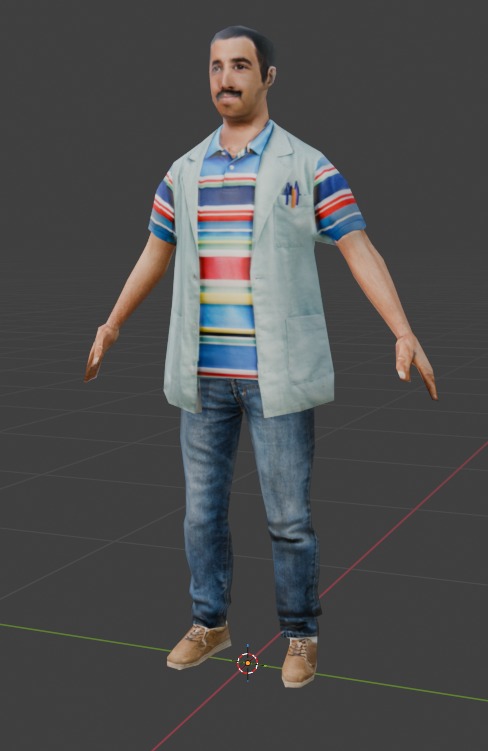
Amara disclosed that he primarily employed Blender 3D to breathe life into the project, with Artificial Intelligence serving as a sophisticated co-pilot. Through this software, he sculpted every model from scratch, from the intricate interior and exterior chassis of the cars to the passengers themselves, rendered exactly as he remembers them. He even populated the virtual space with the essential cast of the tram’s daily theater: the kamsari (ticket collector), the inspector, and the driver.
He placed these characters within the carriages to narrate the quiet stories he witnessed during his own commutes. He recalls, for instance, a nomadic street peddler hawking household wares with a wit so sharp and engaging it compelled passengers into spirited conversation. He also captured those quintessentially Alexandrian moments: the tram pausing beside a local bakery so the driver and kamsari could fetch fresh bread for breakfast, while passengers waited in a comfortable, silent pact. In these moments, they were not strangers but a sprawling family; the Raml Tram was a microcosm of Alexandrian society in its entirety.
A Collective Metropolitan Effort
Amara noted that the project spanned roughly two months of intensive labor. Throughout this period, he shared dispatches of his progress across social media, met with resounding acclaim from a public that soon became active collaborators. Residents provided vital technical nuances that sharpened the project’s fidelity.
This communal data included specific tram car serial numbers and the colloquial names of various mechanical components. Followers even shared personal archives of photographs, allowing Amara to reconstruct the environment with surgical precision.
Navigating the Challenges of Craft
Amara admitted that the primary hurdle was a total absence of original engineering blueprints for the vintage carriages. This forced him into a labyrinth of deep research, using AI tools to identify obscure parts before hunting for visual references. Often, he had to rely on “mechanical intuition,” deducing the form of the Raml Tram’s specific components by studying analogous machinery from the same era.
He leaned heavily on photography to reconstruct the visible textures of the passenger cabins, focusing on the weathered seats, the vintage advertising placards, and the official instructional signage. Recreating the passengers in a way that felt authentic to the Alexandrian “soul” was equally paramount.
Another challenge arose regarding the carriage numbers; a lack of initial data risked historical inaccuracy. However, the vigilance of the Alexandrian public on social media corrected these small errors, ensuring the digital record remained true to the facts.

Ready for a Virtual Commute?
Amara describes the current iteration of the project as a dynamic 3D model. The tram cars move along a continuous loop, allowing the viewer to witness the rhythmic sway and slight vibration of the carriage as the city’s lampposts and power lines flicker past in a nostalgic blur.
Users can observe passengers in various tableaus or navigate the interior by interacting with numerical prompts. These “teleport” the viewer to specific vantage points: the driver’s cabin, the kamsari’s station, or the inspector’s perch—each a window into the daily rituals of a bygone era.
Amara expressed profound gratitude for the outpouring of local support, with many praising the work as the definitive 3D visual archive of the Raml Tram. While many have inquired about expanding the project to include other lines or evolving it into a fully realized video game, Amara maintains that while a game is a compelling possibility, such an evolution would require a significantly greater investment of time and creative labor.
