



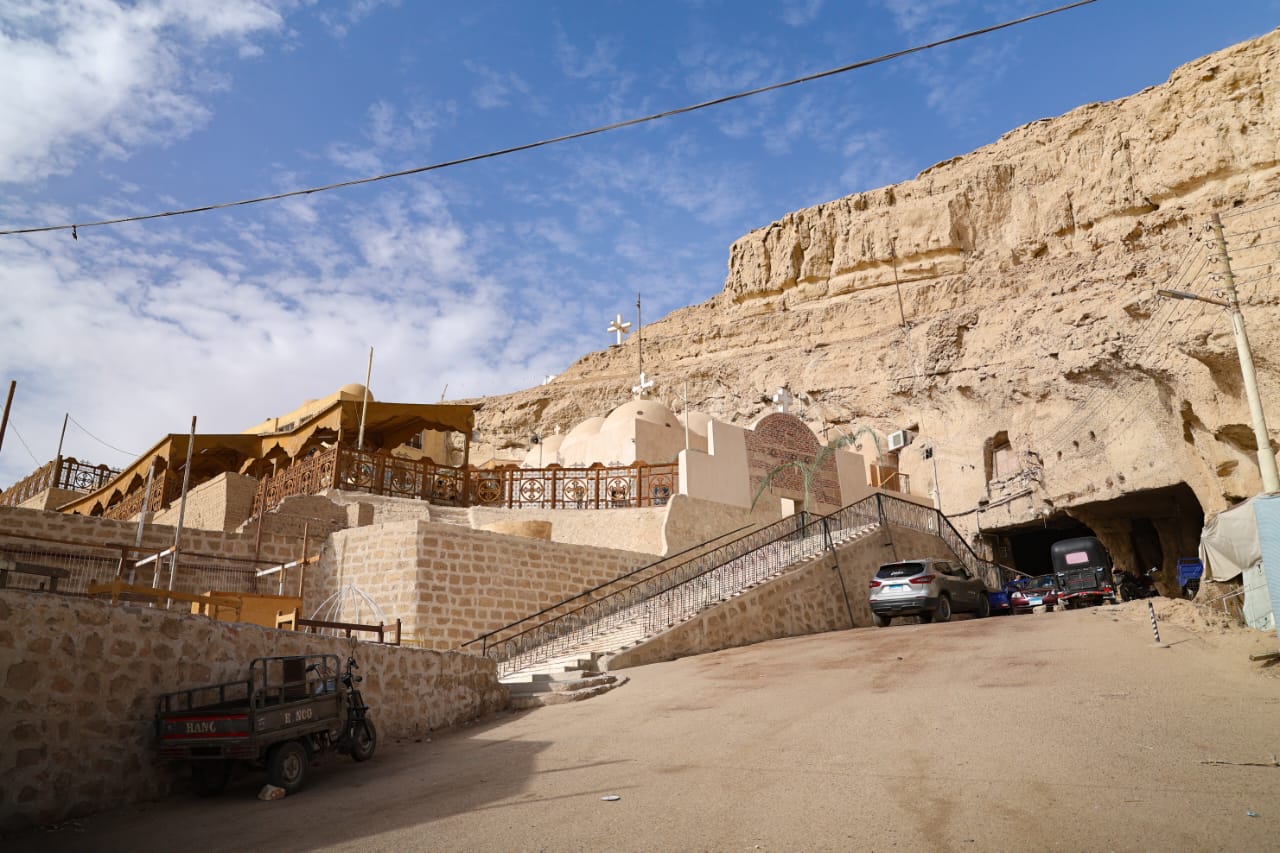
High atop the rugged cliffs of Assiut, the ancient Monastery of Abu Maqrufa preserves a hallowed legacy of Coptic monasticism. Explore the sacred history, rock-hewn sanctuaries, and restored sixth-century frescoes of Deir al-Janadla a desert sanctuary where Pharaonic caves meet the enduring spirit of the Holy Family’s journey.
Perched within the rugged embrace of the Assiut mountains, the Monastery of Abu Maqrufa famously known as Deir al-Janadla stands as a profound testament to the enduring pulse of monastic life in Upper Egypt. For centuries, this sanctuary has harmonized the austerity of the desert with the zenith of Coptic artistry. Through its rock-hewn sanctuaries and ancient iconography, the monastery reveals a layered tapestry of history, serving as both a hallowed archaeological treasure and a living vessel of faith.
The Chronicles of Abu Maqrufa
Ali Ahmed Mahfouz, Director of Islamic and Coptic Antiquities for West Assiut, notes that Deir al-Janadla sits approximately 38 kilometers from the city of Assiut, anchored three kilometers west of the village that shares its name. Mentioned by the medieval historian al-Maqrizi as “Abu Maqrufa,” the monastery is a marvel of troglodytic architecture, carved directly into the face of the Western Mountain.
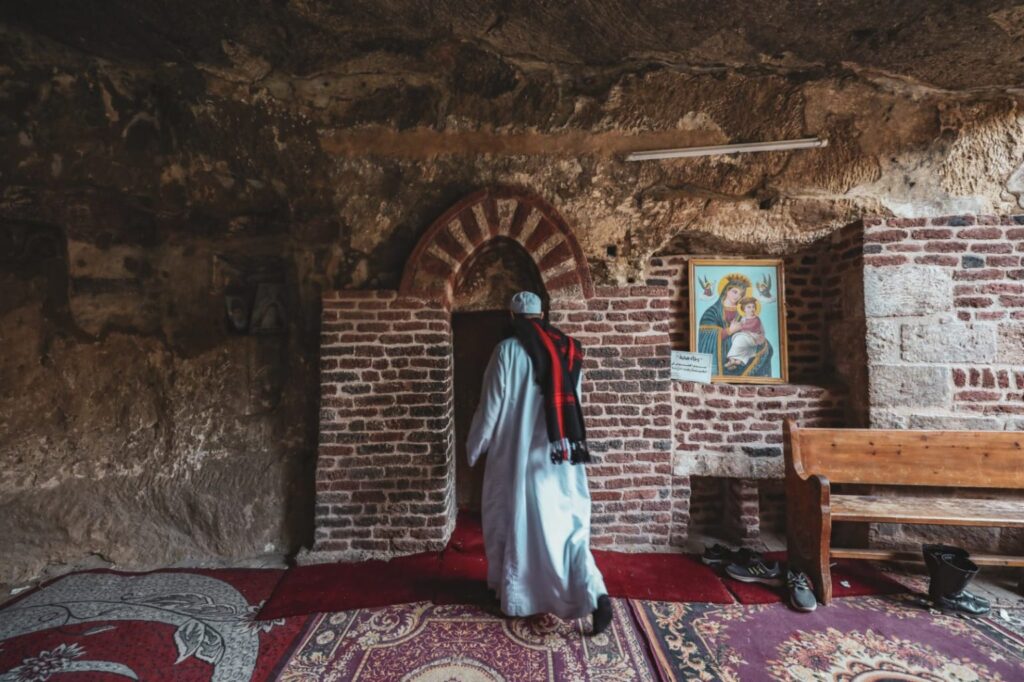
Mahfouz explains that the site was reclaimed for Coptic liturgical life long ago, with its foundational elements dating back to the sixth century. Among its most vital structures is a rock-cut church dedicated to the Virgin Mary and the Church of Saint Peter and Saint Paul, the latter established during the Ottoman era in 1765.
A Bastion of Stone and Spirit
The monastery is girded by a formidable external wall, a structural hybrid where the lower foundations of heavy stone meet an upper reach of sun-dried mud brick. This double-walled fortification, devoid of protrusions to prevent scaling, was meticulously designed to preserve the monks’ interiority (spiritual solitude), shielding them from the distractions of the secular world in accordance with ascetic law. Deep within the complex lies a well plunging 45 meters into the earth; its first 15 meters are carved from the living rock, while the remainder is lined with polished stone a marvel of hydraulic engineering that remains functional to this day.
The archaeological sanctity of the monastery is found in its rarity and its early witness to the faith. Red and black ink inscriptions dating back to the first century suggest that the seeds of monasticism were sown here in the earliest days of Christianity. The art within mirrors the trajectory of the Coptic soul: a “childhood” phase of primitive simplicity, a “youthful” flowering in the sixth century, and a sophisticated maturity marked by the botanical and geometric motifs that flourished well into the 19th-century Ottoman period.
Resurrecting the Sacred Walls
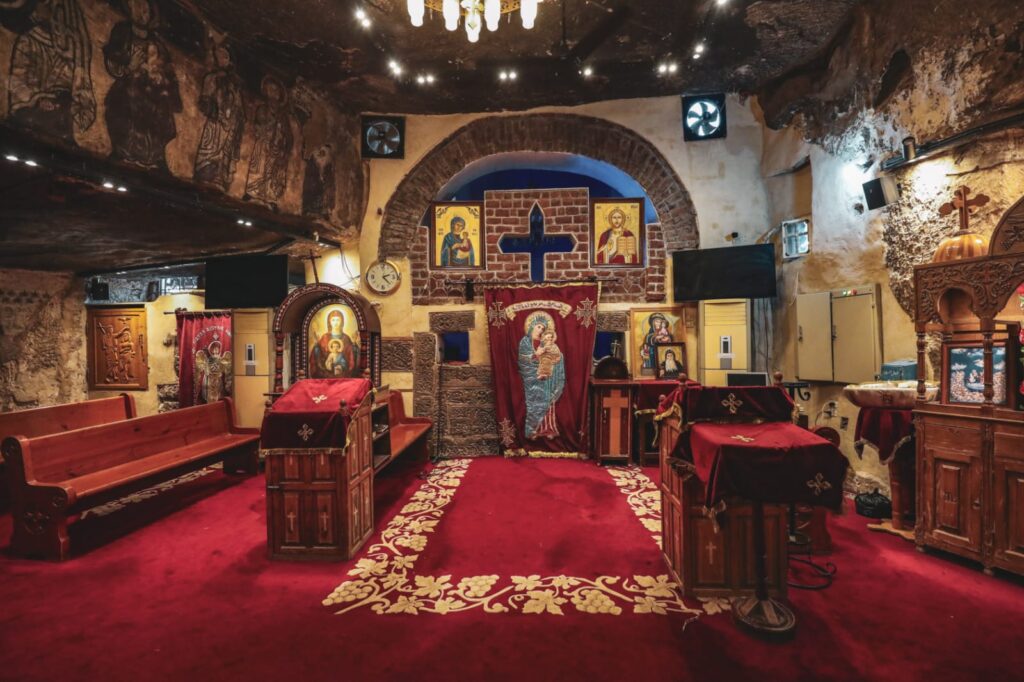
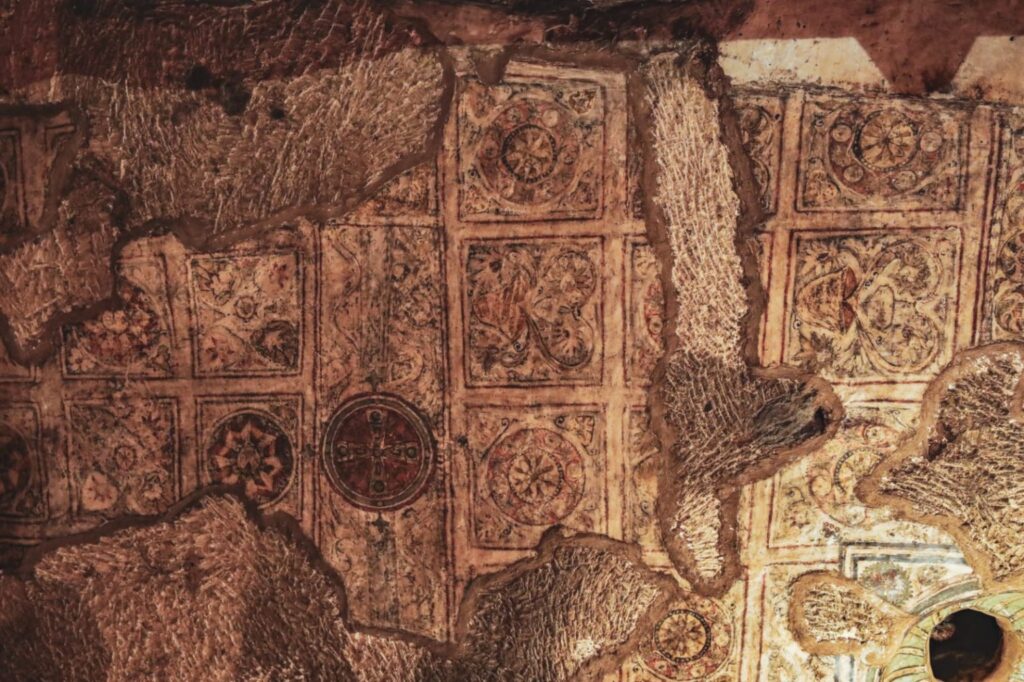
Recognizing its fragility, the Supreme Council of Antiquities launched a comprehensive restoration initiative. Time had etched cracks into the sanctuary walls, and the ethereal wall paintings had been clouded by the soot of winter fires used for warmth. Since 2010, specialized teams have worked to salvage the central iconostasis (the screen separating the sanctuary from the nave), which had fallen into severe decay. During these delicate operations, hidden brick ornamentations were rediscovered beneath the arches.
The Church of Saint Peter and Saint Paul also underwent a structural resurrection after suffering from deep fissures and separations. The monastery serves as a symphony of architecture and art; its walls are adorned with diverse frescoes botanical, human, and calligraphic featuring ancient Coptic script. During restoration, previously obscured details emerged: the intricate folds of saintly garments and hidden Coptic letters, all of which have been meticulously documented to preserve the site’s heritage.
The Legacy of Abba Maqruphius
Father Tadros al-Orashalimi, the guardian of the Monastery of the Virgin Mary, speaks of the site as a hallowed station where the Holy Family is believed to have rested during their flight. He attributes the monastery’s formal founding to Abba Maqruphius, the son of King Qau. Born in 490 AD and tutored by the priest Abba May Sis, Maqruphius arrived at this mountain in 520 AD. He established a constellation of five adjacent monasteries that eventually housed over two thousand monks and nuns. One was reserved exclusively for women, and together, these communities became beacons of education and healthcare for the surrounding region.
The fame of Maqruphius’s virtues reached Pope Theodosius in Alexandria, who summoned the ascetic to the Great City and ordained him as a priest. Upon his return, the inhabitants of three villages greeted him with olive branches and palm fronds, forever linking his name to the site as “Abu Maqrufa.”
The Stone and the Shepherd
The name “Deir al-Janadla” was solidified later, inspired by the “Jandul” (cataract-like boulders) that define the local landscape. Abba Maqruphius passed away in 554 AD, but the location of his remains was lost to time for seven centuries. It was eventually rediscovered by a deacon named Lus al-Tallawi, who, while searching for lost sheep in the mountains, stumbled upon the intact body of the saint alongside a stone tablet bearing his name.
Tradition holds that the saint’s body was placed upon a camel that wandered three kilometers before coming to a definitive halt at the current monastery site. He was interred beneath the altar. The church itself was originally a Pharaonic cave dating to the first century, which Maqruphius transformed into a house of worship in the sixth century, featuring altars for the Archangel and the Virgin, a baptistery, and three distinct entrances.
The Architecture of the Soul
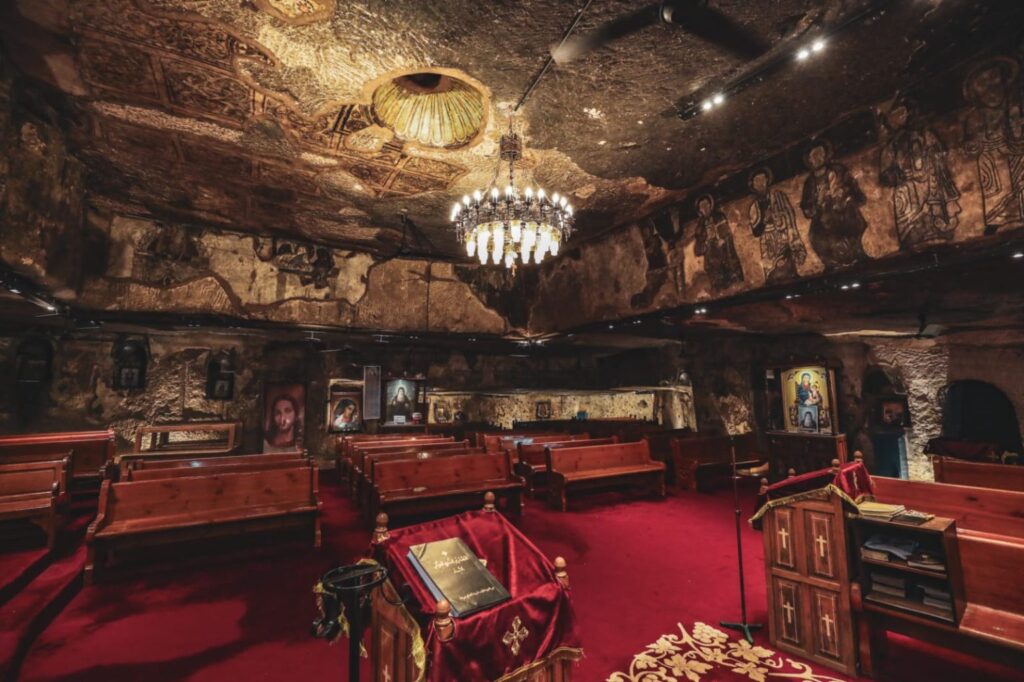
The church is divided into three successive khourses (sections), descending in level to reflect a spiritual hierarchy. The first, and highest, is reserved for the faithful prepared for the Divine Mysteries (the Eucharist). The ceiling above is heavy with symbolism, depicting the oblation bread and the chalice. In the center, a dome is marked by 24 green lines representing the celestial ranks of angels, surrounded by frescoes from the 8th and 10th centuries.
Within these walls, layers of history literally rest upon one another; two tiers of frescoes depict the Disciples with Christ and the Archangel Gabriel. Tragically, much of this art was scarred in the late 18th century. As the French Campaign advanced into Egypt, Mamluk forces fled to the south, leading to the desecration of several monasteries. During this period of abandonment, outlaws took refuge in the caves. Haunted by the piercing gaze of the saints in the icons feeling as though the holy figures were watching their every move the intruders scratched out the eyes of the paintings to find relief from their own guilt.

The Path of the Catechumens
The second section is the Khors of the Catechumens, intended for those who have embraced the teachings of Christ but have not yet received the sacrament of baptism. This area is anchored by a stone minbar (pulpit) a high rock with four steps carved directly into the mountain from which the priest would deliver sermons on the foundations of faith.
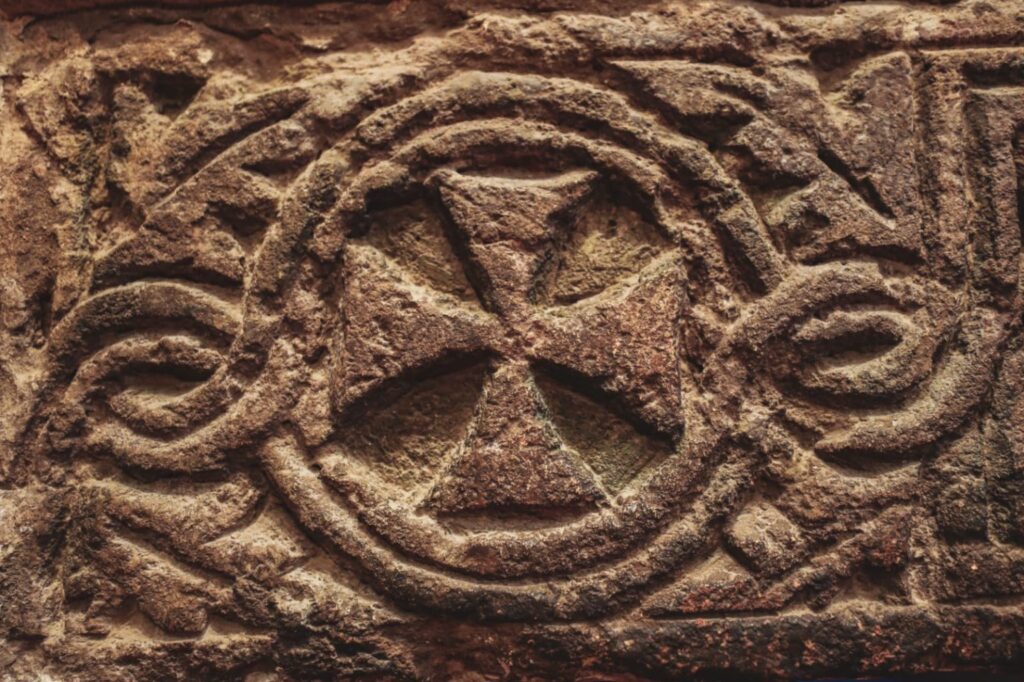
Ten small niches are carved here, symbolizing the Ten Commandments received by Moses; the first four on one tablet, the six remaining on the second. Above them, two rows of stars encircle the church, representing the saints, crowned by crosses inscribed with Coptic letters signifying the name of Christ.
The Place of Weeping
The final section is the Khors of the Penitents (the Weepers), the lowest in spiritual rank, where those new to the faith or seeking repentance would gather. A singular aperture in the ceiling is said to have once dripped sacred oil on special occasions. Here stands an iconostasis fashioned from stone quarried in the first century and engraved in the sixth.
Father Tadros highlights a specific stone etched with vines, olives, and a dove symbols of the Church’s mysteries and the Holy Spirit. Nearby, an Ankh (the key of life) is repurposed as a cross, and a partial fish motif serves as an ancient cipher for Christ, drawing on the early Greek associations of the fish with purity and baptismal grace. Today, the monastery serves the dioceses of Abu Tig, Sedfa, and Al-Ghanayem, drawing pilgrims from across the land who seek the blessing of a ground once trodden by the Holy Family.
