



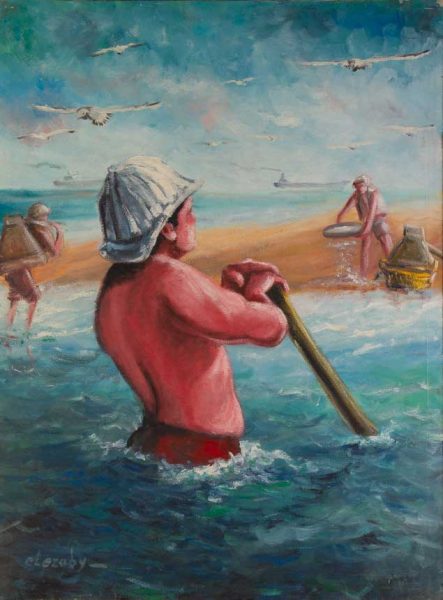
Just before sunset, as the blue sea water is tinged with the red of the setting sun, a small boat moors on the shore of Crocodile Lake, offering um al-khalul for sale or cooked as a light meal to enjoy while sitting by the lake.
In the cities of the Suez Canal, fishing for “Um Al-Khaloul” is linked to popular heritage, with songs dedicated to it on the samsimia instrument, telling of the fishing and the sweet taste of this marine creature, which has many names in different cities, as well as how it is cooked or salted.
The emergence of “Um Al-Khaloul”
The khulul appeared prominently in a painting by Mustafa Al-Azbi, one of the most prominent artists interested in the local cultural environment of the city of Port Said, which was first exhibited in September 1999. According to his son, Mohsen Al-Azbi, it was also made famous by the folk song “Taza wa Ala ya Um Al-Khalul” (Fresh and High, O Mother of Khalul), with lyrics by the poet Kamel Eid. It was performed by the Port Said Folk Arts Troupe.
In a study by Dr. Hamdi Suleiman, professor at the Faculty of Education at Al-Arish University, he says: “Fishing and selling khulul is present in the popular culture of the Suez Canal cities. It is sung on the samsimia instrument, and it is the same song that vendors sing in the markets to attract customers.”
On his boat, the fisherman serves khulul soup in the famous Ismailian style, where it is cooked with a little oil, onion, and garlic after being soaked in fresh water to remove the sand. It is then simmered over low heat until the shells open, and two cups of water are added until it is cooked. The soup is served alone with lemon and cumin and chili spices to taste. The clams are served in a separate dish with lemon.
Seafood
Khalul is a seafood dish rich in zinc, minerals, and vitamins, and is popular as an evening meal or side dish with fish. It accounts for 42% of fish production in the Temsah and Marah lakes in Ismailia, according to statistics from the Fisheries Authority.
Dr. Hamdi Suleiman presented his research paper at the Popular Heritage Conference, marking the 150th anniversary of the Suez Canal (Palaces of Culture Authority 2022). In it, he presented the folk heritage and customs of fishing for khul, as a primary occupation for a large number of fishermen in the city of Ismailia in the Temsah and Marah lakes overlooking the Suez Canal. It and snails appear as a large part of the lakes’ production, and the name of the marine creature belonging to the snail and shellfish family differs between Um al-Khalul and Bakloiz in the cities of the Suez Canal. It is called Jundufli by the people of Alexandria.
Lake Temsah and the lakes
Catching khulul from Lake Temsah and Lake Marah is done in two ways: the first is with a shovel surrounded by a net, attached to the stern of a fishing boat, with a pointed end that can scoop up the sand at the bottom of the lake until the shellfish appear on the surface and can be caught from inside the net. Another method, known as the “karak” and “mahaza,” requires two people, one of whom scoops from the bottom with the karak and throws it to his colleague, who holds the mahaza. He filters out the sand and extracts the clams from the strainer.
Some people fish by hand, diving and searching for clams in the sand. The shovel method is used in the bitter lakes south of Ismailia. This is because the depth of the lake does not allow for manual fishing for clams.
The types vary according to shape, size, and place of fishing. The fisherman sorts the clams, removes the empty shells and stones, and separates them according to size.
The study continues: “Khulul al-Arais is the largest species in Lake Temsah, known for its reddish or black color and soft texture. This species is found in abundance in Ismailia. As for ”Khulul al-Sabaa and Balti,” they are eaten salted without cooking and are known for their small size and are famous in the city of Port Said.
The fishing season for khulul varies in the cities along the canal, with summer being the ideal time for fishing in Lake Timsah in Ismailia. Fishing increases in Port Said in winter, when shellfish ripen in the Mediterranean Sea. Therefore, fishermen in Port Said are forced to endure the cold weather and dangerous waves to collect khuloul from the sea sand.
Taza wa Aal Ya Um Al-Khalul
The song “Taza wa Aal Ya Um Al-Khalul” is famous for being performed by the Port Said Folk Arts Troupe in the 1980s in a famous dance show featuring the artists Aida Riad and Mushira Ismail.
Before they left folk dancing and turned to acting. The samsimia player Al-Reis Hassan Al-Ashri also performed the song in a jam session. He said, “Um Al-Khalul is sweet and delicious, Um Al-Khalul… When I catch it, I sift it… But the small ones, I take them.”
The connection between singing and fishing customs in coastal cities was noted by Dr. Kawk Tawfiq, a professor at the French Institute of Oriental Archaeology. In a research paper presented at the Arab Music Conference in November 2021 at the Opera House, she discussed the musical works of sailors and fishermen, especially those related to food and fishing.
The researcher referred to the observations of German ethnographer Hans Alexander Winkler on the existence of the samsimia instrument in the Hamata and Al-Qusayr regions on the Red Sea, among a tribe that mainly works in fishing. This confirms the connection between the instrument and its presence in cafes and ports in coastal cities and its connection to sea songs.
Fishing
According to the Atlas of Popular Traditions published by the Authority for Cultural Palaces, Um al-Khalul enjoys a special status among fishermen.
The words of a graceful local dance were composed to express these rituals to a wonderful rhythm. The dance depicts the fishing profession of “Um al-Khalul” on the seashore and the sale of their catch to lovers of this type of sea shell.
The dance and song “Um Al-Khalul” begin with a divided rhythm (one and a half) in the first couplet of the song. Then it moves to a maritime rhythm (tubahira) in the second couplet. This variety of rhythms, between slow and fast, with sesame notes, gives the dance a wonderful and unique aesthetic appearance.
The lyrics were written by the Port Said poet Kamel Eid, who wrote them and then set them to music with the samsimia and sahbajiya. The song spread and they created a beautiful dance that expresses its lyrics.
Khaloul Port Said and Sardya Suez
In the popular markets of Port Said, in front of the ferries on the Suez Canal, you will find carts selling small salted khaloul, which is eaten as a snack while crossing the canal or as an appetizer with lunch and dinner.
In the city of Suez, other types of marine creatures belonging to the snail family are famous. Although they are caught in areas far away in the Gulf of Suez and the Red Sea, they are sold in shops on Al-Gomhoureya Street and Al-Namsya Street.
There, Abdul Rahman stands using a small knife to open the sardine shells after they have been grilled. They are eaten fresh, as long as they are opened immediately before eating.
Oysters in Suez have different names depending on the shape and type of shell; the most famous are “sardine, tomato, lojz, sarma, and shal.”
Read also:
Here lived French pop icon Claude François, the stranger who became the “son of Ismailia”
